
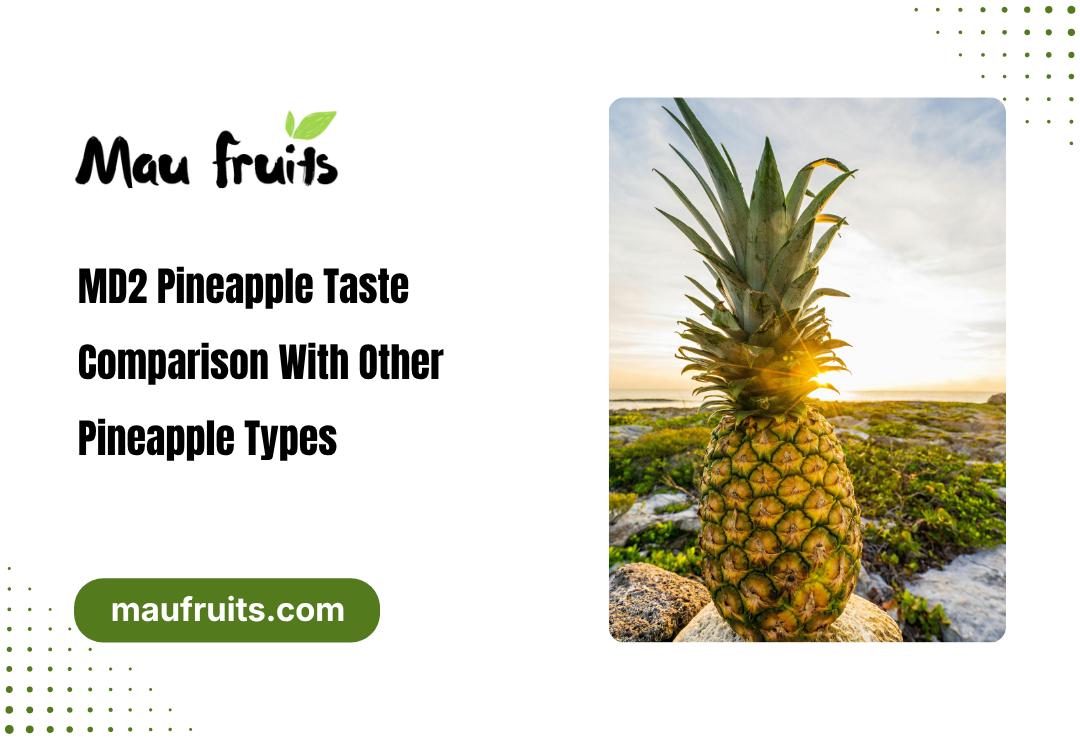
If you have ever wondered why the pineapple you buy at a premium supermarket today tastes so dramatically better than the ones you remember from a decade or two ago, this MD2 pineapple taste comparison will give you the complete and thoroughly documented answer. The MD2 pineapple is not marginally sweeter or slightly less acidic than the varieties it has progressively displaced in global fresh pineapple trade. It is categorically and measurably superior to every competing pineapple type across every dimension of taste quality that sensory science and consumer research can measure, from Brix score and acidity level through flavor complexity and texture to the aromatic profile and aftertaste persistence that distinguish a truly exceptional fruit from a merely acceptable one.
At Mau Fruits, we source and celebrate the finest tropical fruits available, and the MD2 pineapple’s dominance of our pineapple range reflects the same quality assessment that has made it the dominant fresh pineapple variety in international markets worldwide. This complete MD2 pineapple taste comparison covers every major pineapple type currently grown commercially, examining each head-to-head with the MD2 pineapple across the full spectrum of taste and eating quality characteristics that matter to consumers, retail buyers, and culinary professionals.
The Science of Pineapple Taste: What the MD2 Pineapple Taste Comparison Measures
Before conducting a meaningful MD2 pineapple taste comparison, it is essential to understand what pineapple taste is actually composed of at a scientific level and why the specific parameters used to measure it reflect genuine differences in eating quality rather than arbitrary technical specifications. Pineapple taste is the product of four primary biochemical dimensions that interact to produce the total sensory impression: sugar content measured by the Brix scale, organic acid content expressed as percentage of fresh weight, the ratio of these two values which determines the sugar-acid balance that governs perceived sweetness, and the aromatic volatile compound profile that determines flavor complexity and fragrance intensity.
The Brix scale measures the percentage of dissolved sugar solids in fruit juice, with higher scores indicating greater sweetness potential. The organic acid content determines the sharpness and brightness of the flavor, with lower acidity contributing to a rounder, fuller sweetness experience when combined with high Brix. The sugar-acid ratio, often expressed as the sweetness index, is the single most predictive measure of consumer preference in fresh pineapple sensory evaluations because it captures the interaction between these two primary flavor drivers rather than treating them as independent variables. And the aromatic volatile compound profile, including the terpenes, esters, lactones, and sulfur compounds that give each pineapple variety its characteristic fragrance and flavor complexity, determines the depth and distinctiveness of the eating experience beyond the basic sweetness and acidity parameters.
The MD2 pineapple taste comparison with other varieties demonstrates superiority in all four of these dimensions simultaneously, a combination that no other commercially available pineapple type achieves. Understanding how and why it achieves this across the board is the purpose of this comprehensive guide. Discover more about the science of premium tropical fruit quality at our ingredients and spices collection.
MD2 Pineapple Taste Comparison: Understanding the MD2’s Flavor Profile First
Any meaningful MD2 pineapple taste comparison requires a thorough understanding of the MD2 pineapple’s own taste profile as the reference standard against which all other varieties are assessed. The MD2 pineapple was developed specifically to address the flavor limitations of the Smooth Cayenne that dominated global pineapple markets prior to its commercial introduction, and the precision of the quality improvement it achieved across every taste dimension is what makes the MD2 pineapple taste comparison with other varieties so consistently compelling.
A perfectly ripe MD2 pineapple at its quality peak delivers a Brix score of 14 to 16 degrees under optimal growing conditions, representing the highest consistent sugar content of any commercially available pineapple variety. Its organic acid content of 0.4 to 0.45 percent of fresh weight is less than half the acidity of the Smooth Cayenne and significantly below every other major commercial variety. The resulting sweetness index of approximately 35 to 40, calculated as the ratio of Brix to acidity percentage, is roughly twice the sweetness index of the Smooth Cayenne at comparable growing conditions.
The flavor profile that results from this sugar-acid combination is one of rich, concentrated tropical sweetness with multiple layers of complexity. The initial impression is a burst of clean, full, deeply satisfying sweetness with none of the sharp bite that standard varieties deliver. As you eat, the flavor reveals secondary notes of golden honey, ripe stone fruit including peach and apricot, and warm caramel undertones that together create a flavor depth rarely encountered in fresh pineapple. The finish is clean, refreshing, and persistent rather than sharp or acidic, leaving an aftertaste of genuine tropical fragrance that makes each bite as enjoyable in retrospect as it was in the moment. This is the flavor standard against which every other pineapple in the MD2 pineapple taste comparison is measured.
MD2 Pineapple Taste Comparison: MD2 vs Smooth Cayenne
The most commercially significant pairing in any MD2 pineapple taste comparison is the head-to-head with the Smooth Cayenne, the variety that dominated global fresh pineapple trade for decades before the MD2 pineapple displaced it and that remains the most widely grown pineapple variety by total global production volume when all end uses including processing and canning are included. This comparison is the one with the greatest historical commercial relevance and the one that most clearly illustrates why the MD2 pineapple’s arrival in international markets was so commercially transformative.
The Smooth Cayenne typically registers 10 to 12 degrees Brix under commercial production conditions, compared to the MD2 pineapple’s 14 to 16 degrees. This 30 to 40 percent sugar content advantage is immediately perceptible on the palate as the difference between a moderately sweet fruit and a richly, deeply sweet one. The Smooth Cayenne’s acidity level of 0.7 to 1.0 percent is two to three times higher than the MD2 pineapple’s 0.4 to 0.45 percent, creating a sharpness on the palate that competes with and significantly masks the sweetness signal. The Smooth Cayenne’s sweetness index of approximately 12 to 15 compared to the MD2 pineapple’s 35 to 40 represents roughly a three-fold difference in the sugar-acid balance that drives perceived sweetness, a gap large enough to be immediately and unmistakably apparent in blind tasting evaluations.
The Smooth Cayenne also exhibits the uneven ripening pattern that the MD2 pineapple was specifically bred to overcome. A Smooth Cayenne pineapple that is fully ripe and sweet at the base can be significantly underripe, starchy, and astringent at the top near the crown, creating quality inconsistency within individual fruits that disappoints consumers regardless of how carefully they selected their fruit at the market. The MD2 pineapple ripens uniformly from base to crown, ensuring that every slice delivers the same exceptional Brix score and the same low acidity from the first cut to the last. In the MD2 pineapple taste comparison with the Smooth Cayenne, the MD2 wins comprehensively and definitively across every dimension of eating quality, and the scale of its victory explains completely why it has displaced the Smooth Cayenne from premium retail pineapple sections worldwide.
MD2 Pineapple Taste Comparison: MD2 vs Queen and Victoria Pineapple
The Queen and Victoria pineapples represent the most interesting and most nuanced pairing in any MD2 pineapple taste comparison, because these small, intensely flavored varieties grown primarily in South Africa, Mauritius, and parts of Southeast Asia are among the most flavor-complex pineapple types available anywhere in the world and in certain taste dimensions approach or potentially rival the MD2 pineapple’s exceptional flavor quality.
The Queen pineapple delivers a distinctive honey and spice aromatic character that differs from the MD2 pineapple’s fruit-forward tropical profile in ways that connoisseurs find compelling rather than inferior. Its flesh, while small in volume due to the variety’s compact fruit size, is dense, juicy, and intensely flavored with a fragrance and flavor complexity that dedicated enthusiasts rank among the finest available in any pineapple type. The Victoria pineapple of Mauritius shares many of these quality characteristics, with a perhaps even more distinctive and nuanced aromatic profile that has made it a celebrated specialty product in Mauritian tourism and premium export channels.
However, the MD2 pineapple taste comparison with Queen and Victoria varieties reveals a fundamental commercial limitation in both: their post-harvest life of just two to four days at ambient temperature makes them commercially unviable for any supply chain longer than a day or two from production to consumer. They cannot survive the transit periods required for international export trade, which means that consumers outside their specific producing regions will almost never have the opportunity to taste them at anything approaching peak quality. The MD2 pineapple taste comparison with these varieties therefore ultimately concludes in the MD2 pineapple’s favor not because it necessarily surpasses their flavor complexity in every dimension but because it delivers exceptional eating quality consistently and reliably to consumers anywhere in the world, a commercial achievement that no other pineapple type has ever replicated at comparable scale.
MD2 Pineapple Taste Comparison: MD2 vs Red Spanish Pineapple
The Red Spanish pineapple is a widely grown variety in the Caribbean, particularly in Puerto Rico, Cuba, and the Dominican Republic, as well as in parts of Central America and the Philippines. It is one of the oldest commercially cultivated pineapple varieties and has been the basis of significant processing and canning industries in its growing regions for over a century. The MD2 pineapple taste comparison with the Red Spanish is the most clear-cut and least equivocal of all the variety comparisons in this guide, because the Red Spanish’s eating quality characteristics are comprehensively inferior to the MD2 pineapple’s across every measurable taste dimension.
The Red Spanish pineapple typically registers 9 to 11 degrees Brix under standard commercial growing conditions, toward the lower end of the range for commercial pineapple varieties. Its acidity is high, typically 0.8 to 1.2 percent, making it the sharpest and most acidic of the major commercial pineapple types in the MD2 pineapple taste comparison. The resulting sweetness index of 9 to 12 is approximately one-third of the MD2 pineapple’s at comparable conditions, a difference that translates on the palate to a sharp, aggressive, strongly acidic flavor impression with limited sweetness depth or complexity. The Red Spanish’s flesh is also notably fibrous compared to the MD2 pineapple’s relatively smooth texture, creating a coarser eating experience that further reduces its fresh eating appeal relative to the variety that has replaced it in export fresh fruit market consideration.
The Red Spanish’s commercial viability rests almost entirely on its suitability for processing and canning applications where its high acidity is less disadvantageous and where its lower fresh eating appeal is irrelevant to the end use. In the MD2 pineapple taste comparison for fresh consumption, the Red Spanish is clearly and comprehensively outclassed at every level of quality assessment.
MD2 Pineapple Taste Comparison: MD2 vs Abacaxi Pineapple
The Abacaxi pineapple varieties, grown primarily in Brazil where they are highly valued locally for their exceptional juiciness, their delicate sweetness, and their distinctive floral aromatic character, represent one of the more complex and more interesting comparisons in the MD2 pineapple taste comparison series. The Abacaxi, particularly the Perolera subvariety, delivers a flavor profile of genuine distinction: extraordinarily high juice content, a delicate sweetness that is less concentrated than the MD2 pineapple but accompanied by a floral, almost perfume-like fragrance of unusual elegance, and a tender, translucent flesh texture that differs markedly from both the MD2 pineapple’s firmer flesh and the fibrous character of the Red Spanish or older Smooth Cayenne varieties.
In direct sensory comparison, the Abacaxi’s delicate flavor profile appeals particularly to tasters who prefer a less intensely sweet and more aromatically complex pineapple experience, and in a purely subjective flavor comparison without post-harvest performance considerations, some connoisseurs prefer the Abacaxi’s ethereal, floral delicacy to the MD2 pineapple’s bolder, richer sweetness. However, the MD2 pineapple taste comparison with Abacaxi varieties reaches the same commercial conclusion as the comparison with Queen and Victoria: the Abacaxi’s extremely fragile post-harvest life of less than a week at ambient temperature makes it commercially unsuitable for any supply chain longer than very local distribution from its Brazilian growing regions. The MD2 pineapple taste comparison therefore favors the MD2 in all commercially relevant contexts, and Abacaxi remains a Brazilian regional specialty rather than an international competitor.
MD2 Pineapple Taste Comparison: MD2 vs Sugarloaf Pineapple
The Sugarloaf pineapple, also known as the Cowboy pineapple in some West African markets, is a cylindrical, pale-fleshed variety grown primarily in West Africa, Brazil, and parts of Central America. It is notable for its very low acidity, among the lowest of any pineapple variety, which creates a distinctively sweet and mild flavor profile that some consumers find appealing for its complete absence of the sharpness associated with more acidic varieties. The MD2 pineapple taste comparison with the Sugarloaf reveals a variety that shares the low-acidity characteristic that is one of the MD2 pineapple’s most important quality advantages but that fails to match the MD2 pineapple on the sugar content dimension that translates low acidity into genuinely exceptional sweetness.
The Sugarloaf typically registers 12 to 14 degrees Brix, overlapping with the lower end of the MD2 pineapple’s range, but its sweetness lacks the depth and complexity of the MD2 pineapple’s flavor profile, presenting as clean and mild rather than richly concentrated and multi-layered. The pale, white-to-cream flesh of the Sugarloaf is visually less appealing than the MD2 pineapple’s vivid golden-orange interior and reflects lower carotenoid content that represents a nutritional disadvantage alongside the visual one. The Sugarloaf’s post-harvest performance is also more limited than the MD2 pineapple’s, restricting its viable export market geography and commercial scalability. In the MD2 pineapple taste comparison with the Sugarloaf, the MD2 wins on sweetness depth, flavor complexity, visual appeal, nutritional density, and commercial scalability, making it the superior choice across all relevant dimensions for premium export market programs.
MD2 Pineapple Taste Comparison: The Nutrition Dimension
The MD2 pineapple taste comparison would be incomplete without addressing the nutritional dimension of eating quality that increasingly motivates consumer food choices in health-conscious premium markets. The MD2 pineapple’s deep golden flesh color, which is the most immediately visible quality differentiator from paler commodity varieties in direct comparison, reflects elevated concentrations of carotenoid pigments including beta-carotene and other health-promoting antioxidant compounds that make the MD2 pineapple measurably superior to standard varieties in nutritional as well as sensory terms.
One cup of MD2 pineapple delivers Vitamin C at 88 percent of the daily recommended intake, Manganese at 76 percent of the daily value, and active bromelain enzyme complex with documented digestive and anti-inflammatory properties that no other pineapple variety delivers in a comparable package. Research published by the National Center for Biotechnology Information highlights the exceptional biological activity of pineapple-derived bromelain, establishing it as one of the most clinically relevant bioactive compounds available in any fresh tropical fruit and further reinforcing the MD2 pineapple’s position as the nutritionally superior choice in any taste and quality comparison with commodity alternatives. According to Healthline, bromelain’s anti-inflammatory, digestive support, and immune-modulating properties make the MD2 pineapple a genuinely functional food whose health contribution adds meaningful value to the taste quality advantages that drive its consumer preference over competing pineapple types.
Selecting, Storing, and Enjoying MD2 Pineapple at Its Taste Quality Peak
Understanding the MD2 pineapple taste comparison with other varieties is most practically valuable when it helps you select and manage your MD2 pineapple to experience the full quality advantage that makes it the winner of every taste comparison it enters. Look for deep, even golden yellow skin from base to crown, a gentle and consistent yield to moderate palm pressure, a powerful tropical-sweet fragrance at the base, and a stem button that comes away cleanly to reveal bright green flesh beneath. These four indicators together confirm an MD2 pineapple at or very close to peak taste quality.
Store unripe MD2 pineapple at room temperature for three to seven days to allow full flavor development. Never refrigerate before peak ripeness as temperatures below 7 degrees Celsius before full ripening can inhibit the sugar and aromatic volatile compound development that creates the exceptional flavor profile that makes the MD2 pineapple the winner of every taste comparison it enters. Once fully ripe, refrigerate at 7 to 10 degrees Celsius and consume within four to five days to enjoy the full taste quality that the MD2 pineapple taste comparison so clearly demonstrates is the finest available in any commercially accessible pineapple variety anywhere in the world.
For more expert guides on premium tropical fruit taste, quality, and selection, visit the Mau Fruits Blog. Discover our full range of premium tropical produce at Mau Fruits, learn about our sourcing philosophy on our About Us page, or reach out to our expert team through our contact page. We are always here to help you find and enjoy the finest tropical fruits the world has to offer at their absolute best.