

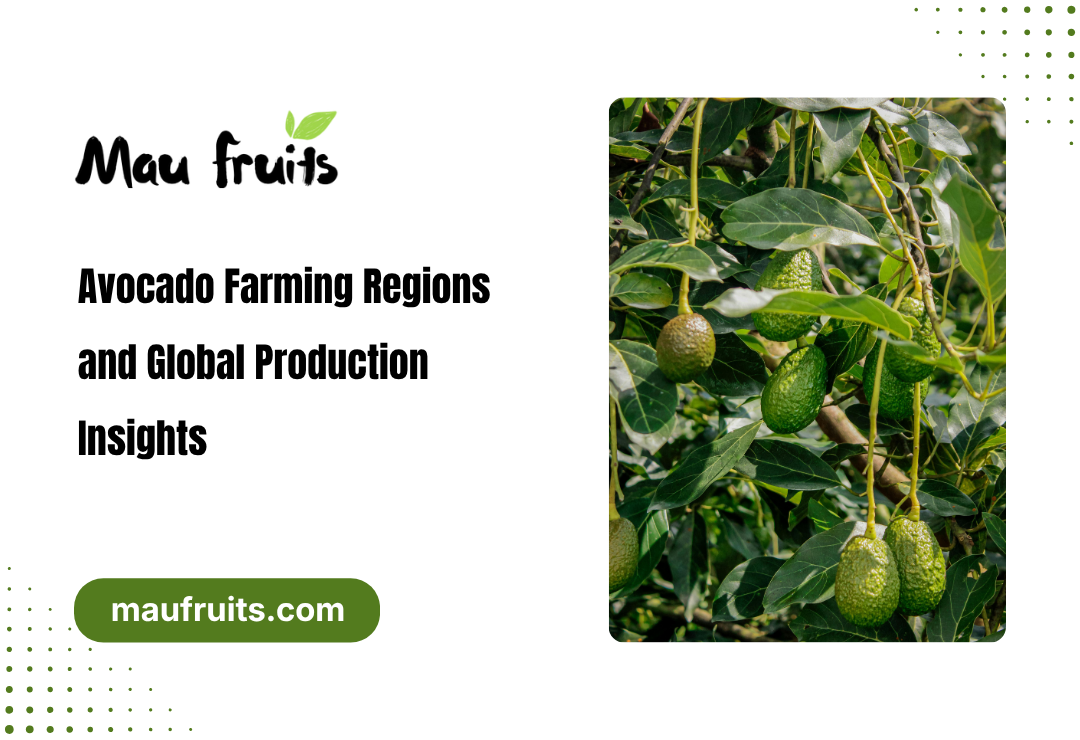
The avocado that arrives on your plate, creamy, golden, and nutritionally extraordinary, has almost certainly traveled thousands of kilometers from one of a small number of specialized avocado farming regions that together supply the world’s insatiable demand for this premium superfruit. Understanding avocado farming regions and global production insights is not merely an academic exercise. It is the foundation for understanding why avocado quality varies, why availability fluctuates seasonally, why prices move the way they do, and how the commercial infrastructure of international avocado trade is evolving to meet the demands of a consumer base that has grown from tens of millions to hundreds of millions in the span of a single generation. The geography of avocado farming is a story of extraordinary agricultural success, growing environmental responsibility, and the relentless pursuit of quality that defines the premium fresh produce industry at its best.
At Mau Fruits, we source premium tropical produce from the world’s finest growing regions and follow the global avocado production landscape with genuine expertise. This complete guide examines every major avocado farming region in detail, the agronomic and climatic factors that determine regional quality, the production volumes and trade flows that shape international availability, and the sustainability challenges and innovations that will define avocado farming regions in the decade ahead.
What Makes an Ideal Avocado Farming Region?
Before examining individual avocado farming regions, it is essential to understand the specific climate, soil, and topographic conditions that allow the avocado tree to express its full quality potential. The avocado, botanically classified as Persea americana, is a subtropical and tropical evergreen tree with precise environmental requirements that strictly limit the geographic zones where premium commercial production is possible.
Climate Requirements Across Avocado Farming Regions
The ideal avocado farming region combines mean annual temperatures between 20 and 28 degrees Celsius with freedom from frost throughout the year. The Hass avocado, which dominates approximately 80 percent of global commercial production, is particularly sensitive to temperature extremes. Frost events even as brief as a few hours can devastate entire orchard blocks, destroying both current-season fruit and the flowering structures required for the following year’s crop. This frost sensitivity is the most fundamental constraint that defines the geographic boundaries of viable avocado farming regions worldwide, effectively confining commercial production to tropical and subtropical latitudes with adequate elevation or maritime climate moderation.
Rainfall management is equally critical in avocado farming regions. The avocado requires between 1000 and 2000 millimeters of annual precipitation for optimal production, but it is the distribution of that rainfall rather than the total quantity alone that determines its suitability for avocado farming. Well-distributed rainfall that maintains consistent soil moisture without waterlogging is ideal. Avocado farming regions with concentrated wet seasons and prolonged dry seasons require supplementary irrigation infrastructure as a prerequisite for sustainable production, a capital requirement that shapes the economics of development in emerging avocado farming regions significantly.
Soil Requirements in Avocado Farming Regions
The best avocado farming regions are characterized by deep, well-drained, slightly acidic soils with a pH between 5.5 and 7.0 and sufficient depth to accommodate the avocado tree’s extensive root system. Drainage is the single most critical soil characteristic in avocado farming, because the variety is highly susceptible to Phytophthora root rot under waterlogged conditions that can devastate entire orchards within weeks of infection establishment. The fertile volcanic soils of Michoacán in Mexico, the well-structured alluvial soils of Peru’s coastal irrigation valleys, and the deep clay-loam soils of South Africa’s Limpopo Province are all examples of the soil profiles that support the world’s most productive and highest-quality avocado farming regions. Learn more about our premium tropical produce sourcing at our About Us page.
Mexico: The World’s Dominant Avocado Farming Region
No examination of global avocado farming regions can begin anywhere other than Mexico, which accounts for approximately 30 percent of global avocado production and an even larger share of international fresh avocado export trade. Mexico’s dominance of the global avocado farming landscape is not accidental. It reflects the extraordinary convergence of near-ideal natural growing conditions, centuries of agricultural expertise accumulated by indigenous and mestizo farming communities, significant private and government investment in production infrastructure, and the favorable market access secured through the NAFTA and subsequently USMCA trade agreements that opened the enormous United States market to Mexican avocado exports.
Michoacán: The Heart of Mexico’s Avocado Farming Region
The state of Michoacán in western Mexico is the geographic heart of the world’s most important avocado farming region, producing approximately 80 percent of Mexico’s total avocado output from orchards concentrated in the municipalities of Uruapan, Peribán, Tancítaro, and Los Reyes. The avocado farming conditions in Michoacán are genuinely exceptional: volcanic soils of extraordinary fertility derived from the Trans-Mexican Volcanic Belt, elevations between 1500 and 2500 meters above sea level that moderate temperatures to the ideal range for Hass avocado quality development, annual rainfall of 1200 to 1600 millimeters distributed across a long wet season, and a dry season that supports the flower induction stress period the avocado tree requires for reliable annual production.
Michoacán’s avocado farming region produces fruit of outstanding quality that has established Mexico’s commercial reputation in premium markets worldwide. The combination of volcanic soil fertility, high-altitude temperature moderation, and the accumulated expertise of Michoacán’s farming families has created a production system of extraordinary commercial sophistication that ranges from small family operations of a few hectares to large vertically integrated enterprises managing thousands of hectares with their own packhouses, cold-chain logistics, and direct export programs serving major retail buyers in the United States and Europe.
Sustainability Challenges in Mexico’s Avocado Farming Region
The extraordinary commercial success of Mexico’s avocado farming region has not been without significant environmental controversy. Deforestation of pine and fir forest in Michoacán to create new avocado orchards has been extensively documented by environmental organizations and has prompted both Mexican government regulatory responses and supply chain due diligence investigations by European retail buyers operating under increasingly stringent anti-deforestation procurement policies. Water management in some Michoacán production areas has also attracted scrutiny as intensive irrigation demand from expanding avocado orchards places pressure on local aquifer systems. The Mexican avocado industry is responding through improved regulatory enforcement, satellite monitoring of land use change, and farmer certification programs, but these sustainability challenges remain ongoing concerns that will continue to shape the commercial landscape of Mexico’s avocado farming region through the coming decade.
Peru: The Rising Star Among Global Avocado Farming Regions
Peru has been the most dynamic growth story in global avocado farming regions over the past fifteen years, transforming from a minor regional supplier into the world’s second-largest avocado exporter with production concentrated in the irrigated coastal valleys of La Libertad, Ica, Lima, and Ancash on the Pacific coast. Peru’s emergence as a major avocado farming region has been driven by a combination of geographic advantages, agricultural investment, and a counter-seasonal production window relative to the Northern Hemisphere that allows Peruvian avocado to fill European and North American supply gaps when Mexican production is seasonally lower.
The Peruvian avocado farming region benefits from a unique combination of desert climate, reliable Pacific trade winds that moderate temperatures, and year-round access to irrigation water from Andean rivers that descend to the coastal valleys where most production is concentrated. This combination of low humidity that reduces fungal disease pressure and reliable irrigation that eliminates rainfall dependency creates a highly controllable production environment that supports consistent quality and allows farming operations to plan their production programs with exceptional precision.
Peru’s avocado farming regions produce Hass avocado of excellent quality that competes effectively with Mexican origin fruit in European markets, particularly during the May to September window when Peruvian production peaks and Mexican volumes are seasonally reduced. The competitive pricing that Peru’s lower land and labor costs enable has been a significant driver of Peruvian avocado farming region expansion and has contributed to the supply diversification that European retail buyers have deliberately pursued to reduce their dependence on any single producing country.
Chile: The Southern Hemisphere’s Established Avocado Farming Region
Chile is one of the most established Southern Hemisphere avocado farming regions, with commercial production concentrated in the Coquimbo and Valparaíso regions of north-central Chile where the Mediterranean climate provides warm, dry summers and mild, wet winters that support Hass avocado production of good commercial quality. Chilean avocado farming has a production seasonality that partially overlaps with Peru’s and provides additional Southern Hemisphere supply to European and North American markets during their respective winter and spring supply windows.
Water scarcity is the most significant constraint on the long-term development of Chile’s avocado farming regions. The Coquimbo and Valparaíso regions are among the most water-stressed in South America, and the high water requirements of avocado production have been associated with significant community water access conflicts and aquifer depletion concerns that have attracted international attention and prompted regulatory responses aimed at limiting further expansion of irrigation-dependent avocado farming in the most severely affected watersheds. This water constraint is likely to limit the long-term growth trajectory of Chilean avocado farming regions regardless of the commercial demand signals from export markets.
Colombia: The Fastest-Growing New Avocado Farming Region
Colombia has emerged as one of the most exciting and most commercially significant new entrants in global avocado farming regions over the past decade, with production concentrated in the departments of Antioquia, Cauca, and Tolima where high-altitude tropical conditions between 1500 and 2200 meters above sea level create near-ideal environments for Hass avocado quality development. Colombian avocado farming has attracted significant foreign direct investment from European and North American agribusiness interests seeking to develop new supply sources to serve their respective home markets.
Colombia’s avocado farming regions offer several distinct competitive advantages over established producers. Proximity to the United States and European markets via both Atlantic and Pacific shipping routes provides logistics flexibility that reduces transit costs compared to more distant producing regions. Year-round production capability across Colombia’s diverse altitudinal gradient allows supply continuity that reduces seasonal concentration risk. And competitive land and labor costs create a favorable production economics environment that supports profitable operation at price points competitive with established producers.
Kenya and East Africa: Emerging Avocado Farming Regions of Growing Importance
Kenya has established itself as the most significant avocado farming region in Sub-Saharan Africa, with production concentrated in the central highlands around Murang’a, Kirinyaga, and Meru counties where the volcanic soils, reliable rainfall, and equatorial highland temperatures between 15 and 26 degrees Celsius create excellent conditions for Hass avocado production. Kenya’s avocado farming region primarily supplies European markets through established export programs that have been growing consistently as Kenyan producers invest in the quality management and certification systems required for access to premium retail buyers.
The economic development significance of Kenya’s avocado farming region extends well beyond its export value. Avocado farming has become an important smallholder income source for tens of thousands of Kenyan farming families who have intercropped avocado trees with food crops or converted marginal land to avocado production in response to the strong and growing export price signals from European markets. The development of cooperative marketing systems and out-grower programs linking smallholder producers with commercial packhouses and exporters has been instrumental in enabling Kenya’s avocado farming region to meet the scale, consistency, and certification requirements of European premium retail market access. Discover premium African-origin tropical fruits at our ingredients and spices collection.
Ethiopia, Tanzania, Zimbabwe, and South Africa complete the East and Southern African avocado farming region landscape, each contributing growing export volumes to European and Middle Eastern markets. South Africa’s avocado farming region, concentrated in the Limpopo Province and KwaZulu-Natal, has a long history of commercial production and well-developed export infrastructure, with South African avocado exported to European markets under the Southern Hemisphere production window that complements Northern Hemisphere supply and supports year-round retail availability for European consumers.
Spain: Europe’s Own Avocado Farming Region
Spain has developed a commercially significant avocado farming region in the Axarquía coast of Málaga province in Andalusia, where a unique subtropical microclimate moderated by the Mediterranean Sea and protected from cold northerly winds by the Penibética mountain range creates conditions warm enough for year-round Hass avocado production at the northern edge of the variety’s viable geographic range. Spanish avocado farming produces premium Hass avocado during the autumn and winter season from October to February, providing European retailers with a European-origin supply option that carries significant supply chain sustainability advantages in terms of reduced food miles, lower carbon footprint, and simpler phytosanitary compliance compared to intercontinental imports.
Spain’s avocado farming region has attracted strong interest from European retail buyers seeking to strengthen the sustainability credentials of their avocado sourcing programs, and premium Spanish avocado commands meaningful price premiums over intercontinental origin fruit in some specialty and organic retail channels where European provenance and short supply chain transparency are valued by consumer segments willing to pay for these attributes. However, Spain’s total production capacity is a small fraction of European avocado consumption, meaning that Spanish avocado farming will remain a premium niche rather than a volume supply solution for European markets for the foreseeable future.
The Philippines and Southeast Asian Avocado Farming Regions
The Philippines and Malaysia have both developed avocado farming regions of growing commercial significance, primarily serving the rapidly expanding Asian premium fruit markets including China, Japan, South Korea, Singapore, and the Gulf Cooperation Council countries. Southeast Asian avocado farming regions benefit from geographic proximity to these Asian destination markets that provides competitive logistics advantages over Latin American and African origin fruit when serving Asian buyers, with transit times of four to ten days from Southeast Asian loading ports to major Asian destination markets compared to the three to four week transit required from the Americas.
Philippine avocado farming has a long history, with production distributed across multiple island regions, but it is only in recent years that commercial investment in Hass variety cultivation and export-oriented packhouse infrastructure has begun to develop the Philippine avocado farming region’s potential as a premium export supplier. Malaysian avocado farming, primarily in Sabah and Sarawak states on Borneo, is at a similarly early stage of export-oriented commercial development but is attracting growing investment interest as Asian market demand for premium imported avocado continues to expand.
Global Avocado Production Insights: Supply Chain and Trade Flows
The global avocado trade flows that connect these diverse avocado farming regions with consuming markets worldwide are organized around three primary export corridors that together handle the majority of international fresh avocado trade volume. The Latin America to North America corridor, dominated by Mexico-US trade, is the highest-volume bilateral avocado trade relationship in the world, with the United States importing over 1.5 million metric tons of avocado annually from Mexico alone. The Latin America and Africa to Europe corridor handles the largest number of origin-destination combinations, with Peru, Chile, Colombia, South Africa, Kenya, and Spain all contributing supply to European distribution networks centered on the Rotterdam and Antwerp port facilities. The Southeast Asia and Latin America to Asia corridor is the fastest-growing trade flow, reflecting the rapid development of Asian premium avocado consumption and the investment in shipping logistics that Asian demand growth is motivating.
Post-harvest management across these supply chains is as important to final consumer quality as the agronomic management in the avocado farming regions themselves. Research published by the Food and Agriculture Organization of the United Nations identifies improving post-harvest cold chain management in tropical and subtropical fruit supply chains as one of the most significant opportunities to reduce food loss and improve the proportion of production that reaches consumers in optimal condition, with current post-harvest loss estimates in avocado supply chains ranging from 10 to 25 percent of harvested volume in poorly managed systems. Leading avocado farming regions are investing in non-destructive maturity assessment technology, controlled atmosphere shipping containers, and ripening room management systems that are progressively improving the quality consistency of avocado reaching consumers across all major destination markets.
The Future of Avocado Farming Regions: Trends and Outlook
The geographic landscape of global avocado farming regions will continue to evolve over the coming decade as climate change alters the suitability of existing production areas, as new frontier regions in Africa, Asia, and the Middle East develop commercial production capacity, and as sustainability imperatives reshape the investment decisions of both producers and retail buyers in established avocado supply chains.
Climate change presents both risks and opportunities for avocado farming regions globally. Established high-altitude production zones in Michoacán and the Colombian highlands may face increasing temperature stress as warming trends reduce the altitude-based temperature moderation that currently creates their ideal growing conditions. Coastal regions in Morocco, Tunisia, and southern Europe that are currently marginally suitable for avocado farming may become more commercially viable as temperatures warm. And Southern Hemisphere avocado farming regions in Chile and South Africa may face more severe water stress challenges as precipitation patterns shift under changing climate conditions.
Sustainability certification will become an increasingly non-negotiable market access requirement for avocado farming regions supplying European and North American premium retail, driving investment in water management technology, deforestation monitoring systems, and social compliance auditing programs across all major producing countries. The avocado farming regions that invest most credibly and most comprehensively in these sustainability dimensions will be best positioned to capture the premium pricing and preferred supplier relationships that sustainability leadership increasingly commands in the most commercially valuable export market segments.
For more expert insights into tropical fruit farming regions, premium sourcing, and global market trends, visit the Mau Fruits Blog. Explore our full range of premium tropical fruits at Mau Fruits, or reach out to our sourcing team directly through our contact page. We are always here to help you navigate the world of premium tropical fruits with confidence and genuine expertise.