

If you have ever wondered why the pineapple at your premium supermarket looks so strikingly golden, tastes so uncommonly sweet, and seems almost nothing like the sharp, fibrous pineapples of decades past, the answer is the MD2 pineapple. Having the MD2 pineapple explained in full is one of the most illuminating journeys available to any tropical fruit enthusiast, because the story of this variety touches on plant breeding science, global agricultural trade, consumer health culture, and the remarkable transformation of an entire fresh produce category in the span of three decades. The MD2 pineapple is not simply a better pineapple. It is the pineapple that redefined what a premium fresh pineapple can and should be, setting a new standard of quality against which every competing variety has since been measured and found wanting.
At Mau Fruits, we source and celebrate the world’s finest tropical fruits, and the MD2 pineapple holds a central place in our understanding of premium quality. This complete guide has the MD2 pineapple explained from every angle: its origins, its science, its nutritional profile, its health benefits, its global trade dominance, and everything you need to know to select, store, and enjoy it at its very best.
MD2 Pineapple Explained: What It Is and Where It Comes From
To have the MD2 pineapple explained properly, we must begin at the Pineapple Research Institute of Hawaii in the 1970s, where a team of plant breeders was working to solve a problem that had frustrated the global fresh pineapple trade for decades. The dominant commercial pineapple variety of the era, the Smooth Cayenne, was a deeply imperfect product for fresh consumption. It was acidic, sharp on the palate, unevenly ripening from base to crown, prone to internal browning after cold storage, and delivered a visual profile of pale greenish-yellow skin that communicated nothing of the ripeness or quality that premium fresh fruit consumers increasingly expected.
The breeding program at the Pineapple Research Institute crossed the Smooth Cayenne with the Red Spanish variety and evaluated hundreds of hybrid selections over several years for their quality characteristics. The selection coded MD2, a designation combining the program identifier and selection number that would later become the most recognized variety name in global fresh pineapple trade, consistently outperformed all competing selections across every quality criterion the breeders were evaluating: sweetness, acidity, color development, uniformity of ripening, post-harvest life, and suitability for long-distance cold-chain export. The MD2 pineapple was, by the measures that mattered most to commercial pineapple production, the most successful plant breeding outcome the Institute had ever produced.
Del Monte acquired the variety and invested in its commercial development through the 1980s, conducting large-scale production trials in Costa Rica that confirmed the MD2 pineapple’s extraordinary potential for year-round tropical growing conditions. Del Monte launched the variety commercially in 1996 under the Gold Extra Sweet brand name, Dole followed with its own Gold pineapple program, and the global fresh pineapple market was permanently transformed. Within a decade, the MD2 pineapple had become the dominant fresh pineapple variety in international trade, a position it holds today with a market share that is effectively total in premium retail segments worldwide. Learn more about how premium tropical fruits are sourced and brought to consumers at our About Us page.
MD2 Pineapple Explained: The Science of Its Extraordinary Sweetness
Having the MD2 pineapple explained scientifically requires understanding two distinct but complementary characteristics that together produce its extraordinary sweetness: its elevated sugar content and its dramatically reduced acidity. Both are measurable, both are genetically determined, and both are significantly superior to any competing commercial pineapple variety available in international markets.
The Brix Score: MD2 Pineapple Sweetness Measured
The Brix scale measures the percentage of dissolved sugar solids in fruit juice. A higher Brix score means a sweeter fruit. The Smooth Cayenne, which dominated global markets before the MD2 pineapple, typically registers 10 to 12 degrees Brix under commercial production conditions. The MD2 pineapple consistently registers 14 to 16 degrees Brix across well-managed growing operations, representing a sugar content advantage of 30 to 40 percent over its most significant predecessor. This is not a marginal improvement. It is a dramatic and immediately perceptible quality leap that consumers experience as the difference between a merely acceptable fruit and an exceptional one.
The elevated sugar content of the MD2 pineapple is the product of specific genetic characteristics that accelerate sucrose accumulation during fruit ripening and that maintain elevated sugar levels through the ripening period rather than allowing rapid post-ripening sugar conversion that reduces sweetness in other varieties. This genetic basis for sweetness means that the MD2 pineapple’s superior Brix score is a consistent and reliable characteristic of the variety rather than an occasional result of optimal growing conditions, making it commercially predictable in ways that non-genetic approaches to sweetness improvement cannot replicate.
Low Acidity: Why MD2 Pineapple Sweetness Tastes Even Better Than Its Sugar Content Alone Explains
Perceived sweetness in fruit is not determined by sugar content alone but by the ratio of sugar to organic acid. A fruit with high sugar but equally high acidity will taste sharp because the acid competes with and partially masks the sweetness signal on the palate. The MD2 pineapple addressed this relationship definitively, developing both elevated sugar and dramatically reduced acidity simultaneously in a combination that no other commercial pineapple variety has matched.
Standard commercial pineapple varieties carry acidity levels between 0.7 and 1.0 percent of fresh weight. The MD2 pineapple carries an acidity level of just 0.4 to 0.45 percent, less than half the acidity of its predecessors. At this acidity level, the full sweetness of the MD2 pineapple’s elevated Brix score reaches the palate without competition, creating a clean, full, rich sweetness that is also remarkably comfortable to eat in quantity. Many consumers who previously found standard pineapple irritating to the tongue and lips in larger amounts discover that the MD2 pineapple’s low acidity makes extended consumption entirely comfortable, a practical quality difference that significantly improves the eating experience.
Uniform Ripening: MD2 Pineapple Sweetness from Base to Crown
The MD2 pineapple explained in full must include its uniform ripening characteristic, which ensures that every slice from the base to the crown of the fruit delivers the same Brix score and the same low acidity level. Standard pineapple varieties ripen unevenly, with the base developing full sweetness before the upper portions near the crown, creating quality inconsistency within individual fruits that disappoints consumers regardless of how carefully they selected their fruit at purchase. The MD2 pineapple’s even sugar distribution during ripening eliminates this within-fruit variability entirely, ensuring that the first slice and the last slice deliver identical eating quality. This consistency is both a genuine quality advantage for consumers and a significant commercial advantage for retailers whose customers return specifically because they can rely on the MD2 pineapple to deliver what it promises every time.
MD2 Pineapple Explained: Visual Profile and Color Development
The visual profile of the MD2 pineapple is one of the most recognizable and commercially significant aspects of the MD2 pineapple explained in full. The variety’s characteristic golden color at ripeness is so distinctive and so immediately associated with premium quality that it has become the most powerful single visual signal in the fresh pineapple retail category, shaping consumer expectations and purchase decisions in ways that the pale, ambiguous skin coloration of older varieties never could.
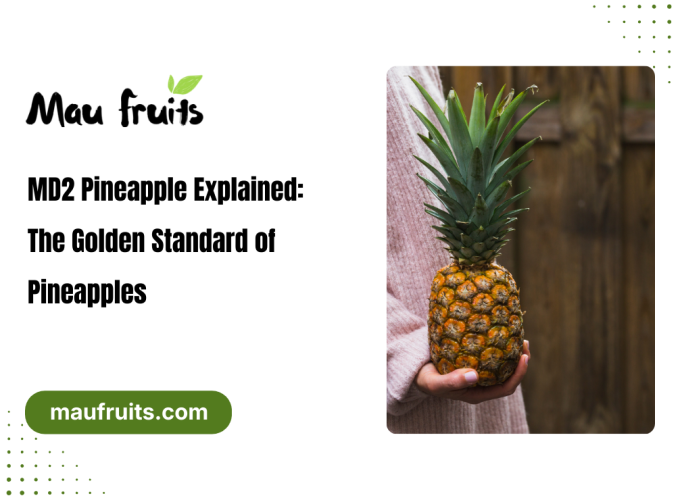
At full ripeness, the skin of the MD2 pineapple is a deep, warm, even golden yellow from base to crown. There is no green banding, no pale patches, and no uneven color development that would create uncertainty about ripeness status for a consumer making a purchase decision without specialist knowledge. The eyes are flat and compact rather than protruding, giving the fruit a smooth, elegant surface profile that further reinforces its premium visual positioning. The flesh inside matches and amplifies the skin’s quality promise: deep golden orange in color, dense and intensely juicy in texture, and visually unmistakable as a fruit of exceptional quality before it is ever tasted.
This deep golden flesh color is not cosmetic. It reflects elevated concentrations of carotenoid pigments including beta-carotene that accumulate in the MD2 pineapple’s flesh during ripening and that contribute directly to its nutritional superiority over paler standard varieties. The color is a reliable real-world indicator of carotenoid content, meaning that the more deeply golden the MD2 pineapple’s flesh, the higher its antioxidant carotenoid concentration and the greater its nutritional value. Explore more premium carotenoid-rich tropical fruits at our ingredients and spices collection.
MD2 Pineapple Explained: Complete Nutrition Profile
The MD2 pineapple explained nutritionally is as impressive as the MD2 pineapple explained in terms of flavor and appearance. One cup of diced MD2 pineapple, approximately 165 grams, delivers the following key nutritional contributions:
- Calories: 82 kcal
- Carbohydrates: 21.6 g
- Dietary Fiber: 2.3 g
- Natural Sugars: 16.3 g
- Vitamin C: 78.9 mg (88% of daily value)
- Manganese: 1.53 mg (76% of daily value)
- Copper: 0.18 mg (20% of daily value)
- Vitamin B6: 0.18 mg (11% of daily value)
- Thiamine (B1): 0.13 mg (11% of daily value)
- Folate: 29.7 mcg (7% of daily value)
- Potassium: 180 mg (5% of daily value)
- Magnesium: 19.8 mg (5% of daily value)
- Bromelain: Naturally active enzyme complex concentrated in flesh and core
- Beta-carotene and carotenoids: Elevated levels reflected in deep golden flesh color
Two nutritional facts about the MD2 pineapple stand out as particularly exceptional. Its Vitamin C content at 88 percent of the daily recommended intake per cup makes it one of the most Vitamin C-dense fresh fruits available anywhere, delivering more immune-critical antioxidant protection per serving than most citrus fruits. Its Manganese content at 76 percent of the daily value per cup makes it one of the single best dietary sources of this often-overlooked mineral that supports bone matrix formation, cartilage synthesis, and the function of manganese-dependent superoxide dismutase, one of the body’s most important cellular antioxidant enzymes. Research published by the National Center for Biotechnology Information highlights the critical role of manganese-dependent superoxide dismutase in protecting cells from oxidative damage, establishing the MD2 pineapple as an outstanding dietary source of nutritional support for this essential antioxidant defense system.
MD2 Pineapple Explained: The Bromelain Advantage
No guide to the MD2 pineapple explained would be complete without a thorough examination of bromelain, the complex of proteolytic enzymes that is the most therapeutically significant bioactive compound in the MD2 pineapple and one of the most extensively researched bioactive compounds in the entire tropical fruit category. Bromelain is found throughout the pineapple plant and is concentrated in the stem, core, and flesh of the fruit, where it functions as a natural protein-digesting enzyme system with documented health benefits that extend well beyond basic digestive support.
Bromelain’s most immediately practical benefit for everyday consumers is its role as a digestive enzyme. After a protein-rich meal, bromelain in the MD2 pineapple helps break down protein molecules in the stomach and small intestine, reducing digestive effort, improving protein bioavailability, and significantly reducing the post-meal bloating and digestive discomfort that protein-heavy meals frequently produce. Eating a portion of MD2 pineapple after a substantial meal is one of the most effective and most enjoyable natural digestive support strategies available in any food.
Beyond digestion, bromelain has demonstrated clinically significant anti-inflammatory effects that make regular MD2 pineapple consumption meaningful for anyone managing inflammatory conditions or seeking to reduce the chronic low-grade inflammation associated with modern dietary patterns. According to Healthline, bromelain has been shown in clinical research to reduce nasal inflammation, joint pain, post-surgical swelling, and exercise-induced muscle soreness, establishing it as one of the most practically versatile bioactive compounds available in any fresh fruit. The bromelain in the MD2 pineapple is delivered within a complex matrix of co-factors and synergistic nutritional compounds that enhance its absorption and biological activity in ways that isolated bromelain supplements cannot fully replicate.
MD2 Pineapple Explained: Health Benefits
The MD2 pineapple explained in terms of health benefits reveals a fruit that delivers genuinely comprehensive health support across multiple body systems simultaneously through the combined action of its vitamins, minerals, dietary fiber, carotenoids, and active bromelain enzyme complex.
Immune system support through the MD2 pineapple’s exceptional Vitamin C content is the most widely recognized of its health benefits. At 88 percent of the daily recommended Vitamin C intake per cup, the MD2 pineapple supports white blood cell production and function, protects immune cells from oxidative damage during active immune responses, and contributes to the maintenance of the skin and mucosal barrier systems that represent the body’s first line of defense against infection.
Bone and joint health benefit from the MD2 pineapple’s extraordinary Manganese content, which supports the enzymatic processes involved in bone matrix formation, cartilage synthesis, and collagen production. Anti-inflammatory cardiovascular protection is delivered through bromelain’s inhibition of pro-inflammatory cytokines and platelet aggregation associated with arterial inflammation and thrombotic cardiovascular risk. Skin health and collagen production benefit from the combination of Vitamin C and Copper, both essential cofactors in the collagen synthesis pathway that maintains skin firmness and wound healing capacity. Digestive health is supported by the combined action of dietary fiber and active bromelain enzymes that together provide comprehensive gut health support from both structural and enzymatic perspectives.
MD2 Pineapple Explained: Global Trade Dominance
The MD2 pineapple explained in commercial terms is a story of unprecedented market transformation. From its commercial launch in 1996, the MD2 pineapple has grown to account for the vast majority of fresh pineapple traded in international markets, displacing the Smooth Cayenne and all other commercial varieties from premium retail segments across Europe, North America, the Middle East, and a rapidly growing Asian market.
Costa Rica is the world’s dominant MD2 pineapple producing and exporting nation, responsible for approximately 60 percent of global fresh MD2 pineapple exports through production concentrated in its Caribbean and Pacific coastal lowlands. Malaysia, Ghana, Kenya, and the Philippines complete the major producing geography, each serving specific regional export market corridors. The European Union is the largest single destination market for MD2 pineapple exports, followed by North America, the Middle East, and Asian markets led by China and Japan where per-capita MD2 pineapple consumption is growing rapidly from a relatively low base.
The MD2 pineapple’s commercial dominance is self-reinforcing through the consumer loyalty it generates. Once consumers experience MD2 pineapple quality, they return specifically for it and resist substitution with inferior alternatives, creating the brand loyalty dynamic that makes the MD2 pineapple the most commercially secure fresh pineapple variety in international trade. Retailers who stock the MD2 pineapple consistently retain the customers who have experienced its quality. This loyalty cycle, combined with the established farming, logistics, and cold-chain infrastructure built around MD2 pineapple production over three decades, creates commercial advantages that no competing variety has come close to replicating. For more insights on premium tropical fruit trade and sourcing, visit the Mau Fruits Blog.
MD2 Pineapple Explained: How to Select, Ripen, and Store It
With the MD2 pineapple explained in full, the practical question becomes how to select and manage this exceptional fruit to capture its quality potential at its absolute best. The selection process is straightforward once you know the reliable ripeness indicators that the MD2 pineapple provides.
Color is your first indicator. Look for deep, even golden yellow skin from base to crown with no significant remaining green areas. A completely golden MD2 pineapple is at or approaching peak ripeness. Any green remaining across the upper half of the fruit indicates that further ripening at room temperature is needed before eating quality is optimal. The squeeze test is your second indicator: cup the fruit gently in your palm and apply moderate pressure at the widest point. A ripe MD2 pineapple yields slightly and consistently without being soft or mushy. The stem button test is your third and most revealing indicator: gently press or flick the small dried stem stub at the very top of the fruit. A ripe MD2 pineapple’s stem button comes away easily and reveals bright green flesh beneath. If the button reveals brown flesh or comes away to reveal a dark cavity, the fruit is overripe. If the button is firmly fixed and reveals very pale flesh, the fruit needs more ripening time. The aroma test is your final confirmation: hold the base close to your nose. A ripe MD2 pineapple produces a powerful, rich, tropical-sweet fragrance that is one of the most unmistakable and reliable ripeness signals available for any fresh fruit.
Store an unripe MD2 pineapple at room temperature between 18 and 24 degrees Celsius for three to seven days to reach full ripeness. Never refrigerate an unripe MD2 pineapple, as temperatures below 7 degrees Celsius before ripening can inhibit normal flavor development and create chilling injury that prevents optimal quality from developing. Once fully ripe, refrigerate between 7 and 10 degrees Celsius and consume within four to five days. Cut MD2 pineapple should be stored in an airtight container in the refrigerator and consumed within three days to enjoy its full quality at its very best.
For more expert guides on premium tropical fruits, their nutrition, culinary applications, and everything in between, visit the Mau Fruits Blog. Discover our full range of premium tropical produce at Mau Fruits, learn about our sourcing values on our About Us page, or reach out to our expert team through our contact page. We are always here to help you find and enjoy the finest tropical fruits the world has to offer.