
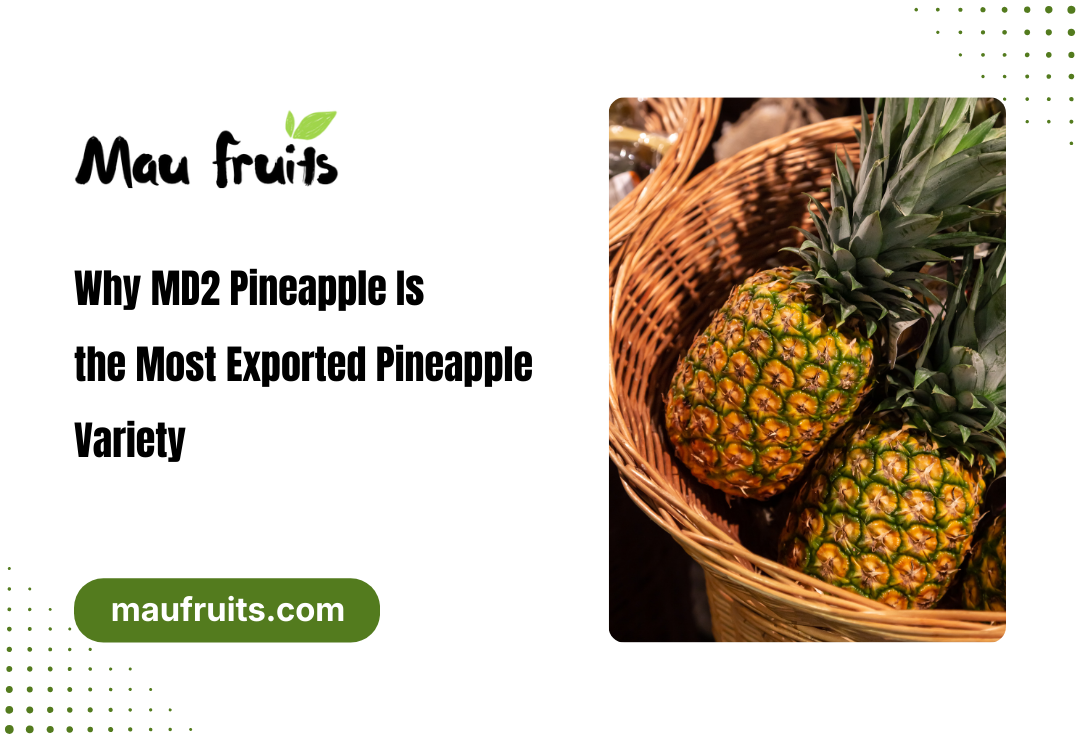
Walk into any premium supermarket in London, Amsterdam, Toronto, Tokyo, or Dubai and the pineapple on the shelf will almost certainly be an MD2 pineapple. The MD2 pineapple export trade has grown from nothing in the early 1990s to become the dominant force in global fresh pineapple commerce, accounting for the overwhelming majority of the estimated 3.5 million metric tons of fresh pineapple traded internationally each year. No other pineapple variety comes close to matching the MD2 pineapple’s commercial reach, consumer recognition, or sustained growth trajectory in international markets. Its dominance is total, its quality reputation is unmatched, and the structural advantages that drove its rise are as powerful today as they were when it first entered global trade three decades ago.
At Mau Fruits, we follow the global tropical fruit trade with genuine expertise and passion. This complete guide examines the seven most powerful reasons why the MD2 pineapple export trade has come to dominate the global fresh pineapple market, the key producing and consuming regions that shape its commercial geography, and the outlook for continued MD2 pineapple export growth in the decade ahead.
The MD2 Pineapple Export Story: From Research Station to Global Dominance
The MD2 pineapple began not as a commercial product but as a research selection code at the Pineapple Research Institute of Hawaii, where plant breeders in the 1970s were working to develop a pineapple variety that addressed the fundamental commercial limitations of the Smooth Cayenne, which had dominated global pineapple trade for decades despite being a deeply imperfect product for fresh consumption and international export. The Smooth Cayenne was sharp, acidic, unevenly ripening, and prone to internal browning after chilling, characteristics that limited the quality of the fresh eating experience it could deliver and created persistent post-harvest quality losses that undermined the economics of long-distance export trade.
The selection that would eventually become the MD2 pineapple was transferred to Del Monte’s research program in the 1980s, where further development and commercial trials confirmed its extraordinary potential. Del Monte launched it commercially in 1996 under the Gold Extra Sweet brand name, and the response from retail buyers and consumers in European and North American markets was immediate and decisive. The MD2 pineapple was sweeter, more visually appealing, longer-lasting in the supply chain, and more consistent in quality than anything the market had previously seen. Within a decade, the MD2 pineapple export trade had transformed the entire global fresh pineapple category.
Today the MD2 pineapple is not merely the most exported pineapple variety. It is the variety that has effectively redefined what a premium fresh pineapple is, creating consumer expectations that no competing variety can reliably meet and a commercial infrastructure of farming operations, export logistics, cold-chain systems, and retail programs built specifically around its unique quality characteristics. Learn more about how premium tropical fruits reach global markets through our About Us page.
7 Reasons the MD2 Pineapple Export Trade Dominates Global Markets
1. Unmatched Sweetness That Drives Consumer Loyalty in MD2 Pineapple Export Markets
The foundation of the entire MD2 pineapple export success story is a single measurable quality advantage that no amount of marketing can manufacture for inferior varieties: the MD2 pineapple is the sweetest commercially available pineapple in the world, and this sweetness is scientifically documented, consistently delivered, and immediately perceptible to any consumer who eats it.
The MD2 pineapple registers between 14 and 16 degrees Brix on the standard sugar content measurement scale, compared to the 10 to 12 degrees Brix typical of the Smooth Cayenne and other commercial varieties. This elevated sugar content is complemented by an acidity level of just 0.4 to 0.45 percent of fresh weight, compared to 0.7 to 1.0 percent for standard varieties, creating a sugar-to-acid ratio that allows the MD2 pineapple’s exceptional sweetness to reach the palate without competition from sharpness or astringency. The result is a flavor experience that consumers in MD2 pineapple export markets describe consistently and universally as superior to any other pineapple they have eaten, generating the repeat purchasing loyalty that sustains commercial demand growth year after year.
Consumer loyalty built on genuine and consistently delivered quality is the most durable competitive advantage available in fresh produce trade, and the MD2 pineapple export market has benefited from this advantage in full. Retailers who stock the MD2 pineapple retain customers who have experienced its quality. Retailers who substitute inferior varieties to capture a temporary price advantage lose those customers when the quality disappointment becomes apparent. This dynamic has progressively consolidated MD2 pineapple export market share at the expense of competing varieties across every premium retail segment it has entered.
2. Superior Shelf Life That Makes MD2 Pineapple Export Commercially Viable at Global Scale
The MD2 pineapple’s extended post-harvest shelf life compared to competing varieties is one of the most commercially critical advantages that has enabled its dominance of global export trade. Fresh pineapple is a perishable commodity, and the economics of long-distance export trade depend entirely on the fruit surviving the weeks of ocean freight transit between tropical producing regions and consuming markets in Europe, North America, the Middle East, and Asia in a condition that meets retail quality specifications and consumer expectations upon arrival.
The MD2 pineapple was specifically selected and developed for superior post-harvest performance compared to the Smooth Cayenne it replaced. It demonstrates significantly better resistance to post-harvest internal browning, a physiological disorder triggered by chilling temperatures that caused widespread quality losses in Smooth Cayenne exports and that limited the distance over which fresh pineapple could be profitably traded. The MD2 pineapple tolerates the cold-chain temperatures of 7 to 10 degrees Celsius required for long-distance sea freight export without developing the internal browning damage that made its predecessor unreliable in distant markets.
This improved chilling tolerance, combined with a firm skin and compact eye structure that resists mechanical damage during handling, packing, and transport, allows the MD2 pineapple to arrive in destination markets in consistently excellent external and internal condition after transit periods of 14 to 28 days depending on origin. This transit performance has been the practical prerequisite for building the MD2 pineapple export trade flows that connect Costa Rican, Malaysian, Ghanaian, and Filipino farms with retail shelves across the globe. Explore more premium tropical produce with exceptional post-harvest performance at our ingredients and spices collection.
3. Consistent Quality That Retail Buyers Demand in MD2 Pineapple Export Programs
Consistency is the quality attribute that major retail buyers in MD2 pineapple export markets value above almost all others. A fruit that delivers an outstanding eating experience on one purchase but a disappointing one on the next destroys consumer trust and retail confidence more effectively than a consistently mediocre product, because the disappointment of unmet expectations is more damaging than the acceptance of reliably average quality. The MD2 pineapple’s exceptional quality consistency, across individual fruits within a shipment, across shipments within a season, and across seasons within a supply program, has been the commercial foundation of its retail category dominance in export markets worldwide.
This consistency is achieved through the MD2 pineapple’s unique combination of genetic characteristics and the farming systems developed specifically to manage them. The variety’s uniform ripening from base to crown, which ensures that every slice of fruit from the base to the top delivers the same Brix score and acidity level, eliminates the quality gradient within individual fruits that created eating disappointment in older varieties. Its predictable response to controlled flowering induction allows farming operations to produce fruit to tight maturity specifications that match retail buyer quality requirements precisely. And its consistent color development at ripeness, transitioning to deep golden yellow across the entire skin surface, provides a reliable visual ripeness indicator that supports consistent retail presentation and consumer selection.
4. Visual Distinctiveness That Commands Premium Pricing in MD2 Pineapple Export Markets
The visual profile of the MD2 pineapple is a commercially significant quality advantage that operates at the point of consumer purchase and that contributes directly to the premium pricing that the MD2 pineapple export trade commands over commodity alternatives. A fully ripe MD2 pineapple is immediately and unmistakably recognizable in a retail display environment. Its deep, even golden yellow skin color from base to crown, its compact and symmetrical form, and its flat, tightly arranged eye pattern give it a visual presence that communicates premium quality and confident ripeness without any additional merchandising support.
This visual distinctiveness was a deliberate outcome of the breeding program that produced the MD2 pineapple. Where the Smooth Cayenne’s greenish-yellow skin at commercial maturity failed to signal ripeness or premium quality to consumers with no specialist knowledge of pineapple variety characteristics, the MD2 pineapple’s golden color development provides an intuitive and reliable quality signal that consumers in any culture and any market can read without education or experience. The deep golden flesh color inside, significantly more vivid than the pale yellow of standard varieties, further reinforces the quality impression and reflects the elevated carotenoid concentration that contributes to the MD2 pineapple’s superior nutritional profile alongside its visual appeal.
5. Nutritional Superiority That Supports Health Positioning in MD2 Pineapple Export Markets
The MD2 pineapple’s nutritional credentials are a growing commercial advantage in MD2 pineapple export markets as health-conscious consumers in premium market segments increasingly seek out fresh fruits with documented functional health benefits alongside exceptional flavor. The MD2 pineapple delivers Vitamin C at 88 percent of the daily recommended intake per cup, Manganese at 76 percent of the daily value, active bromelain enzyme complex with documented digestive and anti-inflammatory properties, and a broad micronutrient profile that makes it one of the most nutritionally comprehensive fresh fruits available at any price point.
The bromelain content of the MD2 pineapple deserves particular attention in the context of health positioning in MD2 pineapple export markets. Bromelain is one of the most thoroughly researched bioactive compounds in the tropical fruit category, with clinical evidence supporting its roles in protein digestion support, anti-inflammatory activity, post-surgical swelling reduction, and sinusitis management that make it of genuine interest to health-motivated consumers. According to Healthline, bromelain has demonstrated significant anti-inflammatory effects in multiple clinical studies, and the MD2 pineapple’s higher flesh quality and superior ripeness at export make its bromelain more bioavailable than that of less carefully managed commodity varieties. This health positioning provides MD2 pineapple export programs with a compelling consumer communication narrative that goes far beyond simple flavor claims.
6. Established Export Infrastructure That Reinforces MD2 Pineapple Export Dominance
The MD2 pineapple export trade has, over three decades of development, built an export infrastructure of farming systems, certification programs, cold-chain logistics networks, and commercial relationships that creates powerful barriers to entry for competing varieties and enormous advantages for established MD2 pineapple export participants. This infrastructure includes hundreds of thousands of hectares of farmland developed specifically for MD2 pineapple production across Costa Rica, Malaysia, Ghana, Kenya, and the Philippines, packhouse facilities equipped and optimized for MD2 pineapple grading and packing specifications, refrigerated shipping container programs managed to the precise temperature parameters that MD2 pineapple export requires, and the commercial relationships between producing country exporters and destination market importers and retailers that have been built through years of consistent quality performance and reliable supply delivery.
This infrastructure represents an enormous accumulated investment that the MD2 pineapple export trade will continue to benefit from for decades, regardless of any competitive challenges from alternative varieties. A new pineapple variety seeking to displace the MD2 pineapple in international export markets would need to not only match or exceed its quality characteristics but also motivate the entire supply chain to rebuild its farming, logistics, and commercial infrastructure around the new variety, a transition cost that creates very high barriers to competitive substitution even for genuinely superior new varieties.
7. Sustainability Certification Alignment That Secures MD2 Pineapple Export Market Access
The MD2 pineapple export trade’s progressive adoption of sustainability certification standards has become one of the most important commercial advantages protecting its market position in premium European and North American retail, where sustainability certification is rapidly transitioning from a premium differentiator to a non-negotiable market access requirement. Leading MD2 pineapple export operations in Costa Rica, Malaysia, and Ghana have invested substantially in GlobalG.A.P. certification, Rainforest Alliance certification, and social compliance auditing programs that satisfy the increasingly stringent sustainability procurement requirements of major retail buyers in these markets.
Research published by the National Center for Biotechnology Information supports the nutritional case for premium pineapple consumption that underpins the health positioning central to MD2 pineapple export market development, while the industry’s sustainability certification investments address the environmental and social credibility requirements that complete the premium market proposition. This dual investment in nutritional credibility and sustainability certification creates a market access package that competing varieties without equivalent certification infrastructure find extremely difficult to replicate in the timeframe that competitive market dynamics demand.
The Geography of MD2 Pineapple Export Trade
The MD2 pineapple export trade is structured around a concentrated production base in tropical regions supplying a large and geographically diverse consumption market through established cold-chain export corridors that have been developed and refined over three decades of commercial operation.
Costa Rica: The Heart of MD2 Pineapple Export
Costa Rica is the world’s dominant MD2 pineapple export nation, responsible for approximately 60 percent of global fresh MD2 pineapple export volume. Its Caribbean and Pacific coastal lowlands provide near-ideal year-round growing conditions, and its proximity to both US and European markets, combined with well-developed port infrastructure at Puerto Limón and Caldera, allows efficient sea freight access to the two largest MD2 pineapple export destination markets. Costa Rica’s established position in the global MD2 pineapple export trade is reinforced by decades of farming expertise, strong producer-exporter commercial relationships, and a regulatory environment that supports export-oriented tropical fruit production.
Malaysia, Ghana, Kenya, and the Philippines
Malaysia serves Asian and Middle Eastern MD2 pineapple export markets from production concentrated in Johor and Perak, its geographic proximity to China, Japan, South Korea, and Gulf Cooperation Council countries providing competitive logistics advantages over Latin American producers for these growing destination markets. Ghana and Kenya supply European MD2 pineapple export markets with cost-competitive fruit that is gaining market share in price-sensitive retail segments without sacrificing the quality standards that European buyers require. The Philippines rounds out the major MD2 pineapple export producing geography with production primarily serving Asian markets through sea freight corridors that deliver fresh fruit in four to eight days transit to major Asian destination ports.
MD2 Pineapple Export Destination Markets: Where the Fruit Goes
The European Union collectively represents the largest single destination market for MD2 pineapple export, absorbing the majority of Costa Rican and African MD2 pineapple export volumes through established import and distribution programs serving retail chains across the United Kingdom, Germany, the Netherlands, France, Belgium, Scandinavia, and the Iberian Peninsula. European consumer familiarity with the MD2 pineapple is now effectively complete in major markets, where it is the default and often the only whole fresh pineapple variety available in mainstream retail.
North America absorbs the second largest share of global MD2 pineapple export volume, with the United States and Canada both representing mature and well-developed markets where MD2 pineapple has displaced commodity varieties across premium retail formats and is gaining ground in mainstream and value retail channels as production cost improvements in Costa Rica make competitive pricing increasingly achievable at lower retail price points. The Middle East, particularly the Gulf Cooperation Council countries of UAE, Saudi Arabia, Qatar, and Kuwait, represents a high-value and growing MD2 pineapple export destination where consumer preference for premium fresh fruit and strong purchasing power combine to support sustained demand growth at premium pricing.
Asian markets represent the most significant medium-term growth opportunity for MD2 pineapple export. China, Japan, South Korea, and Singapore all show growing consumer preference for premium imported tropical fruit, and the MD2 pineapple’s quality credentials align strongly with the quality signals that Asian premium consumers respond to. Per-capita MD2 pineapple consumption in major Asian markets remains significantly below European levels, indicating substantial headroom for continued MD2 pineapple export growth as income levels, consumer awareness, and import logistics infrastructure continue to develop.
The Future of MD2 Pineapple Export: Outlook and Opportunities
The structural drivers of MD2 pineapple export growth remain intact and compelling. Consumer preference for premium fresh fruit backed by health credentials and consistent quality is growing structurally in every major consumer market worldwide. Asian market penetration for MD2 pineapple export is at an early stage relative to the scale of the opportunity. Foodservice and hospitality demand for MD2 pineapple is expanding as premium food and beverage operators globally standardize on the variety for its quality consistency and consumer recognition. And the MD2 pineapple’s inherent quality advantages over competing varieties are durable genetic characteristics that no amount of investment in inferior alternatives can match.
The sustainability dimension of MD2 pineapple export will become increasingly important as a commercial differentiator and market access credential over the coming decade. Water management innovation, organic certification growth, deforestation-free sourcing verification, and fair labor practice auditing will all become more central to the commercial proposition of MD2 pineapple export programs as retail buyer requirements and consumer expectations continue to evolve. The MD2 pineapple export operations that invest most credibly and most comprehensively in these sustainability dimensions will be best positioned to capture the premium pricing and preferred supplier status that sustainability leadership increasingly commands in the most valuable export market segments.
For more expert insights into premium tropical fruit trade, market trends, and sourcing best practice, visit the Mau Fruits Blog. Explore our full range of premium tropical fruits and specialty produce at Mau Fruits, or reach out to our team directly through our contact page. We are always here to help you find and enjoy the finest tropical fruits the world has to offer.